Thank you for joining us on the LiBBY Study journey. Enrollment for the LiBBY Study is complete, and topline results are ready to share.
Study Results
The LiBBY Study results only apply to the specific THC and CBD combination of the investigational treatment at the specific dose and delivery system used in this study. These study results do not apply to any other form of cannabis or any other form of publicly available marijuana.
The LiBBY Study results show that the THC/CBD investigational treatment administered as an oral, digestible combination oil reduced the symptoms of agitation, in comparison to the placebo treatment.
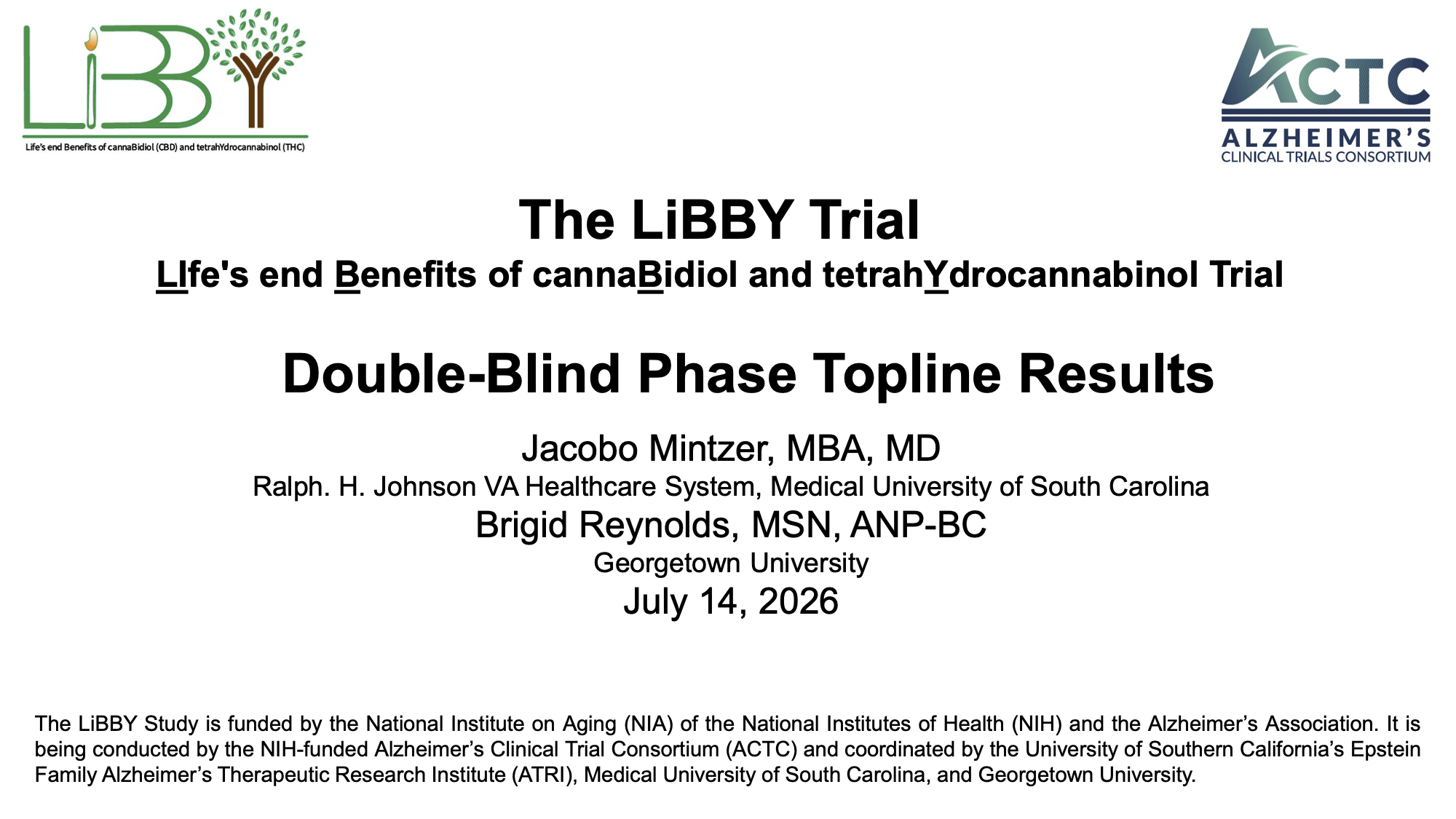
The LiBBY Study results were presented at the Alzheimer’s Association International Conference (AAIC) in London, United Kingdom on July 14, 2026. The slides are publicly available and can be viewed below.
Please continue reading below for the official announcement about the LiBBY Study results.
If you are the Legally Authorized Representative of a LiBBY Study participant, please contact the participant’s study site team directly to learn more, including information about a participant’s individual study results.
FROM THE ALZHEIMER’S ASSOCIATION INTERNATIONAL CONFERENCE 2026
TOPLINE RESULTS FROM LIBBY TRIAL SHOW THC/CBD COMBINATION SIGNIFICANTLY
REDUCES AGITATION FOR PEOPLE WITH DEMENTIA
AT END OF LIFE
Key Takeaways
- A new treatment combining THC and CBD significantly reduced agitation in people with late stage Alzheimer’s and other dementias, who were eligible to receive or received hospice care, with benefits seen in two weeks.
- Nearly 9 in 10 study participants who received the treatment showed overall improvement in target symptoms at study end at week 12.
- The LiBBY study demonstrates that dementia patients at late stages of their illness can participate in clinical trials, helping expand much needed clinical research.
LONDON, July 14, 2026 — A combination of CBD and THC rapidly and significantly reduces agitation in hospice
eligible people with dementia, suggest topline results from the Phase 2 LiBBY (Life’s End Benefits of cannaBidiol and
tetrahYdrocannabinol) clinical trial. The findings were reported for the first time at the Alzheimer’s Association
International Conference® (AAIC®) 2026 in London and online.
“This is a robustly positive, randomized, controlled trial that represents a major step forward in treatment for a population
that has been historically overlooked in clinical research,” said lead investigator Jacobo Mintzer. M.D., Psychiatrist at the
Ralph H. Johnson VA Healthcare System, and Professor, College of Health Professions, Medical University of South
Carolina. “We now have evidence supporting a new and very effective treatment approach for agitation that may be
appropriate for people in the final stages of dementia at the end of life, offering them grace and peace in what is often an
extremely difficult time for patients and their families.”
The multicenter, randomized, double-blind, placebo-controlled study evaluated a novel oral formulation (2 mg THC/100
mg CBD dissolved in digestible oil, provided twice a day) in 120 participants with dementia who were eligible or received
hospice care and experiencing clinically significant agitation. The trial achieved its primary and key secondary endpoints.
Key Findings
- At Week 2, participants receiving THC/CBD showed a 6.27-point greater reduction in agitation scores than those
receiving placebo, which was statistically significant, indicating rapid symptom relief. - Benefits were sustained through Week 12, with participants receiving THC/CBD experiencing an 8.23-point
greater reduction in agitation scores than those receiving placebo. - Clinician-rated global improvement:
- Week 2: 83.9% of treated participants improved vs. 30.5% on placebo.
- Week 12: 87.2% of treated participants improved vs. 23.6% on placebo.
Overall adverse event rates were similar between groups (46.7% vs. 42.4%). Over 12 weeks, 23.3% of participants in the
treatment arm experienced serious adverse events, compared with 11.9% in the placebo arm. Investigators determined
that none of the serious adverse events were related to the study medication.
Agitation affects about half of people living with dementia near the end of life, and more than one-third continue to
experience symptoms despite off-label treatment with benzodiazepines, opioids, and antipsychotics — therapies that can
be difficult to manage and carry significant risks.
In severe dementia and in the late stages of life, agitation is a common neuropsychiatric symptom characterized by
emotional distress, excessive motor activity, and verbal or physical tension. Because individuals in the late stages of
dementia, especially towards the end of life, often lose their ability to communicate effectively, agitation frequently serves
as a direct behavioral signal of physical discomfort, fear, or unmet needs. Symptoms — which may be distressing to
patients, families and caregivers — may include:
- Pacing or wandering
- Fidgeting and repetitive movements
- Loud, sudden vocal outbursts or calling out continuously.
- Repetitive phrases
- Moaning or groaning
- Verbal hostility
- Hitting, kicking, scratching, biting, or pushing others
- Throwing or destroying property
“The LiBBY study directly addresses one of the most challenging and under-discussed aspects of Alzheimer’s disease — end-of-life agitation,” said Elizabeth Edgerly, Ph.D., Alzheimer’s Association vice president, care and support. “These results not only highlight a promising therapeutic option, but also underscore the importance of prioritizing attention, care
and research for individuals in mid- and late-stage Alzheimer’s and related dementias.”
Brigid Reynolds, APRN, a LiBBY study Co-PI and Nurse Practitioner with the Memory Disorders Program at Georgetown University noted, “One of the most meaningful aspects of these findings is the potential to provide a more humane and dignified experience for patients and families. Reducing agitation can help restore a sense of calm and comfort in a very vulnerable time. Proving the clear benefit of THC/CBD over placebo can bring hope to millions of patients, their families, caregivers, and loved ones.”
The Alzheimer’s Association supports a careful, individualized approach to managing behavioral and psychological
symptoms of dementia, and encourages patients, caregivers and clinicians to review the prescribing information carefully
and engage in shared decision-making when considering treatment. Non-pharmacological strategies including
environmental modifications, structured routines and psychosocial interventions are recommended as a first-line
approach.
LiBBY, which was conducted by the National Institute on Aging (NIA)-funded Alzheimer’s Clinical Trial Consortium
(ACTC), is among the first randomized, controlled trials in a hospice-eligible population with dementia.
Paul Aisen, M.D., Director of the Epstein Family Alzheimer’s Therapeutic Research Institute at the University of Southern California and one of the Principal Investigators of ACTC, noted, “The LiBBY study successfully demonstrated that it is feasible to recruit, enroll, and retain a representative cohort from this group, including individuals from historically underrepresented communities. The study introduced novel trial methods to address an essential therapeutic need.”
“This trial shows that high-quality clinical research can and should be conducted in people with advanced dementia,
including those receiving hospice-eligible care,” said Mintzer. “That is essential for achieving equitable and meaningful
progress in Alzheimer’s treatment.” In LiBBY, the participants’ mean age was about 80 years; 55% were female; 58%
from underrepresented ethnoracial groups; and 75% lived in community settings.
The LiBBY trial was a 12-week, Phase 2 study conducted across multiple U.S. sites. Participants with Alzheimer’s or
another disease that causes dementia and significant agitation were randomized to receive either the THC/CBD
combination or placebo.
- Primary endpoint: Change in agitation on the Cohen-Mansfield Agitation Inventory at 2 weeks.
- Key Secondary endpoints: Sustained agitation reduction at 12 weeks and global clinical change at 2 weeks and 12 weeks.
The study’s drug intervention, known as T2:C100, contained 2mg THC and 100mg CBD. From the start of the study
through week 1, participants received a half dose (2mg THC and 100mg CBD, twice daily) or a placebo. During weeks 2–
12, participants received the full intervention dose (4mg THC and 200mg CBD, twice daily) or a placebo.
A 12-week open-label extension phase has been completed and will also be reported at AAIC 2026. The LiBBY trial and
its open-label extension are primarily funded by the NIA, part of the National Institutes of Health (NIH). The Alzheimer’s
Association is a funder of the open-label extension phase.
About AAIC
AAIC is the world’s largest gathering of researchers from around the world focused on Alzheimer’s and other diseases
that cause dementia. As a part of the Alzheimer’s Association’s research program, AAIC serves as a catalyst for
generating new knowledge about dementia and fostering a vital, collegial research community.
- AAIC 2026: alz.org/aaic
- AAIC 2026 online pressroom: alz.org/aaic/pressroom.asp
- AAIC 2026 hashtag: #AAIC26
About the Alzheimer’s Association
The Alzheimer’s Association is a worldwide voluntary health organization dedicated to Alzheimer’s care, support and
research. Our mission is to lead the way to end Alzheimer’s and all other dementia — by accelerating global research,
driving risk reduction and early detection, and maximizing quality care and support. Our vision is a world without
Alzheimer’s and all other dementia®. Visit alz.org or call +1 800.272.3900.
LiBBY Results in the News
Agitation in Dementia Can Be Helped by Medical Cannabis, Study Suggests
A combination of THC and CBD eased symptoms in an especially frail population: patients with advanced dementia near the end of their lives.
The New York Times, July 14, 2026
CHILL PILL Cannabis shown to ease confused and agitated dementia patients ‘with 90% positive results’
Cannabis might help to calm dementia patients by reducing agitation, according to a study.
The Sun, July 14, 2026
Nine out of 10 elderly dementia sufferers become less agitated after marijuana treatment, study finds
Researchers have found that two active ingredients found in marijuana have helped dementia patients suffering from agitation in later life.
The Independent, July 14, 2026
Study: THC, CBD treatment helps late-stage dementia patients
An experimental treatment combining THC and CBD significantly reduced agitation in people with late-stage Alzheimer’s disease and other forms of dementia.
WKRC Local 12, July 20, 2026
Open-Label Extension Results
The LiBBY Study Open-Label Extension results are also now available!
The Open-Label Extension results are specific to the participants enrolled in the LiBBY Study using the specific THC and CBD combination of the investigational treatment and its exact delivery system. These study results do not indicate the safety or efficacy of other THC:CBD formulations or recreational marijuana.
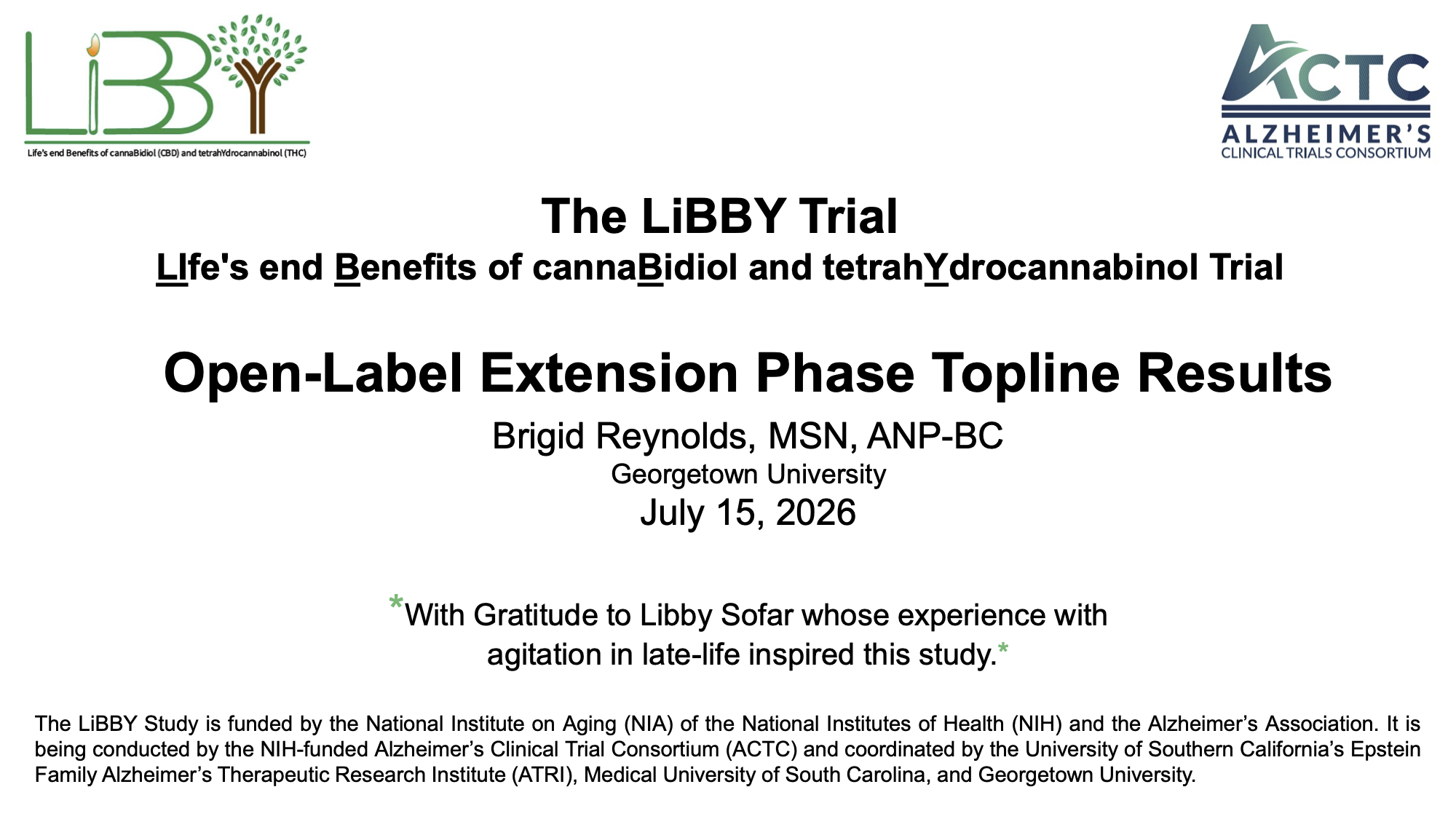
The Open-Label Extension results were presented at the Alzheimer’s Association International Conference (AAIC) in London, United Kingdom on July 15, 2026. The slides are publicly available and can be viewed below.
To all the LiBBY Study participants, caregivers, and study partners, the LiBBY Study team extends its gratitude for your important contributions to researching Alzheimer’s disease and other dementias. Your participation in the LiBBY Study has helped us move science forward and find a new treatment.
For more information on Alzheimer’s disease and related dementia trials, please visit the Alzheimer’s Association TrialMatch service at trialmatch.alz.org